
Italy has been selected as the assembly site for what is set to become the largest aircraft ever built. Named WindRunner, it is a specialized cargo plane designed to transport exceptionally large loads — in particular, next-generation wind turbine components that are significantly larger than those in operation today. Standing roughly as tall as a four-story building, the WindRunner targets a critical bottleneck in renewable-energy logistics.
The project is led by Radia, a U.S. startup founded in 2016 based on the research of Mark Lundstrom, a professor at MIT and an expert in renewable energy. In line with the typical U.S. pathway from lab to market, Lundstrom’s academic work evolved into a venture. The World Economic Forum in Davos recognized Radia as a “WEF Unicorn,” highlighting its growth potential. After evaluating options, the company selected Italy as the most suitable location for assembling and launching the WindRunner.
Solving the transport problem for giant onshore turbines
Lundstrom’s studies indicate that onshore wind turbine blades measuring 104 meters in length — roughly 30 meters longer than current blades — can capture more wind and generate electricity at significantly lower costs than other energy sources, including solar, nuclear, and offshore wind. This enables so-called Gigawind parks, but introduces a practical challenge: transporting these blades, which must remain a single, undivided piece, to their installation sites.
Multiple transport options were analyzed and rejected. Road transport is constrained by curves and tunnels; ships and helicopters are too small; airships are too light to lift a blade weighing up to 72 tons. The remaining solution was an aircraft of unprecedented dimensions — but no such aircraft existed. That gap led to the founding of Radia and the design and fundraising effort behind the WindRunner.
Market strategy and management
“Proportionally, this is the same path Elon Musk followed with Tesla in its early days,” says Giuseppe Giordo, who since May of last year has served as president and CEO of Radia for Europe and Italy. An experienced executive with leadership roles at Alenia North America, Alenia Aermacchi (formerly Finmeccanica), and Saudi Arabian Military Industries, Giordo is tasked with steering the company’s operations in Europe, starting with the Italian program.
Timeline, scale, and industrial partners
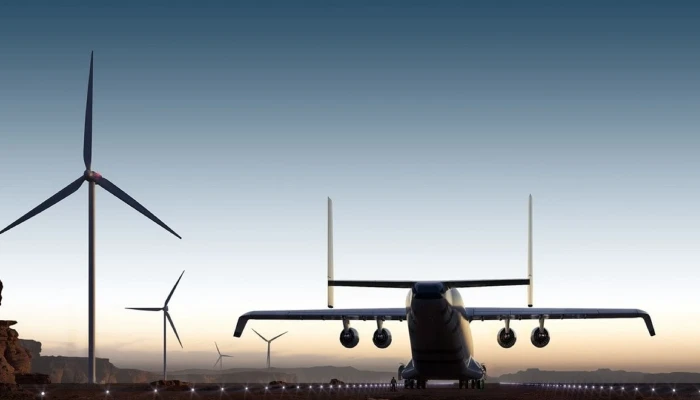
Radia expects to be operational by the end of this year in order to start production in 2029 and make the first deliveries in 2030. The plan calls for producing five aircraft per year, for a total of 120 WindRunners, which will be managed by the U.S. parent company to deliver mega-turbines worldwide.
Key specifications announced to date: a front-loading cargo configuration, overall length of 108 meters, wingspan of 80 meters, and a flight range of about 2,000 kilometers.
Supply-chain agreements have been signed with Leonardo (fuselage), Magnaghi Aerospace in Campania (landing gear), and Spain’s Aernnova (wings), alongside partners in the Netherlands and the United Kingdom. Final assembly is planned in Italy, with Puglia — specifically the Grottaglie plant — in pole position. The program also involves the regions of Campania and Calabria, the latter focusing on workforce training.
Economic impact and policy support
The existing industrial base could attract investments worth several billions and create at least 2.5 million jobs, with indirect effects estimated to be several times higher. Italy’s Ministry of Enterprise and Made in Italy, led by Adolfo Urso, has signed a memorandum establishing a fast-track via a Special Economic Zone (ZES), offering tax advantages and, crucially, accelerated permitting.
“Europe is proving to be a strategic area for Radia’s future, and Italy is a key partner not only for its industrial capacity but also for its shared commitment to accelerating the energy transition,” Lundstrom says. Giordo adds that while the company believes in Italy, bureaucratic processes must move faster than they traditionally do.
Deployment targets exclude countries such as Russia and China. Growth is expected in North Africa and parts of the East, where investment in green-energy generation is rapidly expanding.
Comparison with the Antonov An-225 Mriya
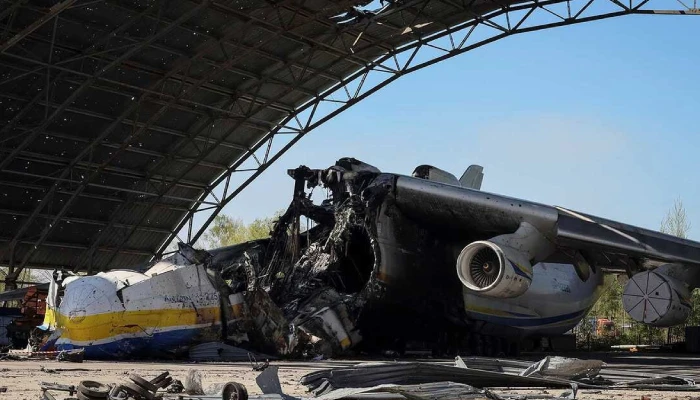
The WindRunner announcement inevitably invites comparison with the Antonov An-225 Mriya, the Ukrainian aircraft destroyed in early 2022 during Russia’s invasion. Built in the 1980s to transport the Soviet space shuttle Buran, the Mriya held multiple records as the world’s heaviest aircraft, with a maximum takeoff weight of 640 tons, a length of 84 meters, a wingspan of 88.4 meters, and a payload capacity up to 250 tons.
While the An-225 was a unique, one-off platform used to move various outsized cargoes, Radia’s plan envisions serial production: up to 120 WindRunners. The WindRunner is longer than the Mriya (108 meters versus 84) but has a smaller wingspan. The use-case also differs: the An-225 served broad heavy-lift missions; the WindRunner is tailored to a single, pressing logistics challenge — transporting one-piece, ultra-long wind turbine blades for large-scale onshore projects.
How it stacks up against other giant aircraft
- Hughes H-4 Hercules (“Spruce Goose”): first flown in 1947 with a record wingspan of 97.5 meters; built largely of wood and flown only once for under a minute. A technological experiment rather than a production cargo system.
- Antonov An-124 Ruslan: a heavy-lift workhorse with a 73-meter wingspan and payload up to around 150 tons; still in limited service for military and outsized industrial cargo.
- Airbus A380: the largest passenger airliner with a 79.75-meter wingspan and very high seating capacity in all-economy configurations; production ended in 2021 due to market shifts, despite ongoing airline operations.
In this context, the WindRunner is notable not only for its dimensions but for being purpose-built around a single logistics problem tied to the energy transition. Where the Spruce Goose was a proof-of-concept, the An-124 a versatile military and industrial transporter, and the A380 a commercial hub-to-hub airliner, the WindRunner is designed to make otherwise impractical renewable-energy projects feasible by enabling transport of components that cannot be moved by road, sea, or lighter-than-air craft.