
TABLE OF CONTENTS
- A Region Built on Fault Lines: The Historical Roots of Endless Conflict
- The Spark That Lit the Fire: Trump, Netanyahu, and Operation Epic Fury
- Why Iran Struck Its Arab Neighbors — And What Those Bases Had To Do With It
- The Strait of Hormuz and the Global Oil Shock
- The NATO Budget and the Cost of Endless War
- What Americans Think: Taxpayers, Troops, and a $1 Billion-a-Day Question
- Who Profits From This War? The Case of Russia
- Nuclear Shadow: Does Iran Already Have the Bomb?
- Dubai, the UAE, and the Collapse of the Gulf’s Safe-Haven Myth
- Ukraine’s Unexpected Role: AI Drones and the Shahed Problem
- What Comes Next: A World Order at the Breaking Point
A Region Built on Fault Lines: The Historical Roots of Endless Conflict
To understand why the Middle East in March 2026 looks the way it does — smoking cities, oil tankers on fire in the Strait of Hormuz, missile alerts pinging on phones from Bahrain to Beirut — you have to go back to the fundamental architecture of the region’s modern political order. It was designed, largely by outside powers, to be unstable.
After World War I, the Ottoman Empire collapsed and the European powers — primarily Britain and France — carved up the region through the Sykes-Picot Agreement of 1916, drawing borders that had little to do with ethnic, religious, or tribal realities. Sunnis, Shia, Kurds, Arabs, Persians, and dozens of smaller groups were lumped together or split apart according to colonial convenience. The borders that resulted from this arrangement planted the seeds of virtually every conflict the region has seen since.
The discovery of oil transformed the strategic calculus. Suddenly, the deserts of the Persian Gulf became the most geopolitically valuable real estate on earth. Great powers rushed to establish relationships with local monarchies, fund competing factions, arm rival governments, and maintain military presences — all in service of keeping the oil flowing. The United States, in particular, built its Middle East strategy on three pillars: Israel as a security anchor, Saudi Arabia as an oil supplier, and military bases as instruments of regional control. Iran was a fourth pillar — until it wasn’t.
The 1979 Islamic Revolution in Iran destroyed the American framework overnight. The Shah, Washington’s ally, was overthrown. Ayatollah Khomeini declared the United States the “Great Satan.” The 444-day hostage crisis that followed set a tone of mutual hostility between Tehran and Washington that has never truly dissipated. Iran’s new theocratic government immediately began building its own regional strategy — cultivating Shia militia networks across Lebanon, Iraq, Syria, Yemen, and the Palestinian territories, creating what would become known as the “Axis of Resistance.”
Throughout the 1980s, the Iran-Iraq War — which killed over a million people and lasted eight years — demonstrated both the destructive capacity and the strategic miscalculations endemic to the region. The United States, in a particularly revealing episode, supported both sides at various points, most infamously supplying weapons to Iran in the Iran-Contra affair while simultaneously providing intelligence and economic support to Saddam Hussein’s Iraq.
The post-Cold War period brought no peace. The 1991 Gulf War, the 2003 invasion of Iraq, the Arab Spring, the Syrian civil war, the rise of ISIS, the Yemen catastrophe — each conflict fed into the next. Iran steadily expanded its proxy network. Israel fought repeated wars with Hezbollah and Hamas. Saudi Arabia and Iran fought a cold war that occasionally turned hot through proxies. The 2015 JCPOA nuclear deal offered a brief window of managed de-escalation, but the Trump administration’s 2018 withdrawal from it effectively dismantled the framework. By the early 2020s, the region was a pressure cooker with no relief valve.
The October 7, 2023 Hamas attack on Israel and the subsequent Gaza war accelerated everything. Israel responded with devastating military force, killing tens of thousands of civilians in Gaza. It then systematically dismantled Iran’s proxy network: assassinating Hezbollah’s leadership, degrading Hamas’s military capacity, and conducting joint strikes with the United States on Iranian nuclear and military infrastructure in June 2025. By early 2026, Iran was isolated, economically strangled, domestically embattled, and strategically weaker than at any point since 1979. That vulnerability, paradoxically, is what made the current war possible — and perhaps inevitable.
The Spark That Lit the Fire: Trump, Netanyahu, and Operation Epic Fury
On February 28, 2026, the United States and Israel launched coordinated military strikes on Iran in an operation codenamed “Epic Fury.” The opening salvo was extraordinary in its ambition: a joint strike that assassinated Iran’s Supreme Leader Ali Khamenei, destroying his compound and killing multiple senior officials alongside him. Within hours, Iran responded with hundreds of drones and ballistic missiles targeting Israel and U.S. military bases across Bahrain, Jordan, Kuwait, Qatar, Saudi Arabia, Turkey, and the United Arab Emirates.
The lead-up to the strikes had been visible for weeks, though Washington and Jerusalem insisted on maintaining ambiguity. By mid-February, the United States had undertaken what analysts described as the largest military buildup in the Middle East since the 2003 invasion of Iraq. Two aircraft carrier strike groups were repositioned. Over 200 military aircraft were deployed to the region. The signals were unmistakable.
The official justification offered by President Trump centered on Iran’s nuclear ambitions and ballistic missile program. In an eight-minute video posted to Truth Social on the night of February 28, Trump said the United States “will ensure that Iran does not obtain a nuclear weapon” and that Iranian forces were “attempting to rebuild their nuclear program” following U.S. and Israeli strikes in June 2025. He framed the operation as a necessary preemption of an existential threat — a preventive strike, not a war of aggression.
Netanyahu, for his part, called the strikes on Iran “the largest Israel has ever launched” and declared a nationwide state of emergency. Der Spiegel, Germany’s flagship news weekly, described a joint war with the United States to attack Iran as “a dream for Benjamin Netanyahu that became true” — though it warned the dream risked becoming a nightmare. Netanyahu publicly stated that Israel could “create conditions for regime change” but that it would ultimately be up to the Iranian people to take to the streets.
The preventive-strike argument is worth examining seriously, because it is not simply propaganda. Iran had spent years building a ballistic missile arsenal estimated at up to 2,500 weapons, with ambitions to expand that to 8,000 — a number that would overwhelm Israel’s layered air defense systems. Its nuclear enrichment had reached 60 percent purity, a technical step away from weapons-grade material. In January 2026, Iran was also brutally cracking down on massive anti-government protests, killing tens of thousands of civilians. Intelligence assessments suggested the regime, weakened domestically and regionally, might calculate that acquiring a nuclear deterrent was its only path to long-term survival — and that if it was going to try, it would move fast.
From this perspective, Trump and Netanyahu concluded that a closing window of Iranian vulnerability created a rare opportunity to permanently degrade a threat that had been growing for decades. The question of whether this calculation was correct — and whether it was worth the costs — is now being answered in real time, in fire and blood, across the entire Middle East.
Critics, including the Center for American Progress and the Arms Control Association, have argued strenuously that the war was a “war of choice” launched in violation of international law, without congressional authorization, and without exhausting diplomatic options. An unnamed U.S. official acknowledged on a press call on February 28 that there was “no imminent nuclear weapons threat” — that the threat was Iran’s “ambition,” not an actual weapon in hand or on the launchpad. The distinction matters enormously, both legally and morally.
Whatever one concludes about the justifications, the consequences are now beyond argument. More than 1,400 Iranians have been killed by U.S. and Israeli strikes. Fifteen Israelis have died. American soldiers have been killed at bases across the Gulf. A school in Iran was struck by what U.S. officials described as a targeting error, killing over 100 children. The IRGC has launched strikes on at least 27 U.S. bases across the Middle East. The conflict has already cost the United States over $26 billion and shows no sign of ending.
Why Iran Struck Its Arab Neighbors — And What Those Bases Had To Do With It
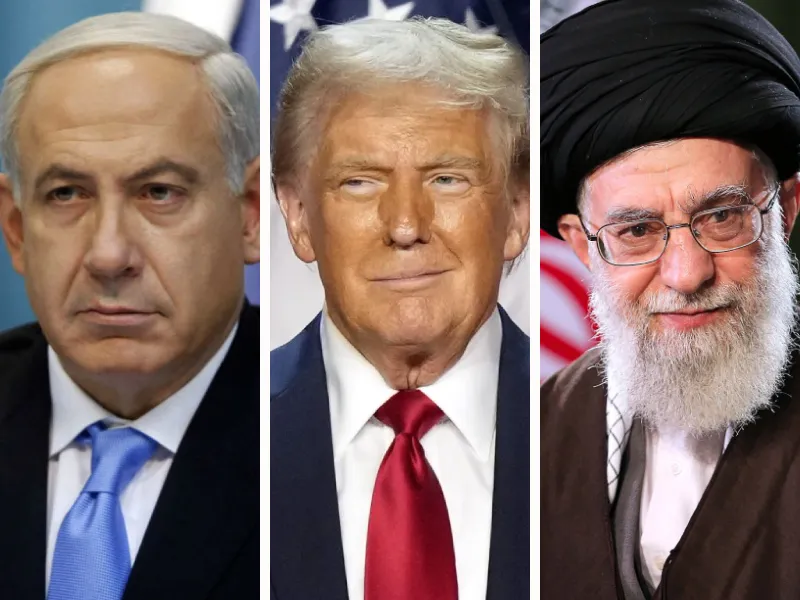
When Iran’s new Supreme Leader Mojtaba Khamenei — appointed after his father’s assassination — issued his first public statement, the core demand was blunt: the United States must close all its military bases in the Middle East. This is not a casual demand. It is the strategic heart of Iran’s counter-offensive.
Iran’s decision to strike not just Israel but the UAE, Kuwait, Qatar, Saudi Arabia, Bahrain, and Jordan — Arab states that officially declared neutrality or even had normalized relations with Iran — shocked many observers. The logic, however, is internally consistent. Iran had warned explicitly and repeatedly that if it were attacked, it would target U.S. military bases and infrastructure across the region. Those bases are in Arab countries. Therefore, Arab countries became targets.
The U.S. military footprint in the Gulf is vast. The Navy’s Fifth Fleet headquarters is in Bahrain. Major air bases and troop concentrations exist in Qatar (Al Udeid), Kuwait, Saudi Arabia, Jordan (Muwaffaq Salti), and the UAE. These are not small forward operating posts — they are major nodes of American power projection. Iran views them as the infrastructure of American hegemony and, now, as the logistics chain for the war being waged against it.
The IRGC’s Khatam al-Anbiya Headquarters declared flatly that any vessel or facility linked to the United States and Israel “will be considered a legitimate target.” Iran has struck the U.S. Navy’s Fifth Fleet headquarters in Bahrain’s Juffair district multiple times. Iranian missiles hit Abu Dhabi’s airport and landmark sites. Dubai International Airport and the Burj Al Arab area were struck by drone debris. Qatar’s LNG facilities were hit, forcing a declaration of force majeure and halting production at the world’s largest LNG export plant. Saudi Arabia has intercepted dozens of drones over its eastern region, where its crucial oil infrastructure is located.
Britain’s RAF base at Akrotiri in Cyprus was struck by an Iranian drone — the first direct hit on a NATO installation from a non-NATO state since the alliance’s founding. A French service member was killed in Iraq after a pro-Iranian group announced it would target French forces. The conflict has reached NATO’s borders not metaphorically but literally, as weapons produced in Iran now strike European military soil.
The Gulf states find themselves in an impossible position. They have U.S. defense guarantees and host U.S. bases, which makes them targets. But they also need to keep their own populations safe and their economies functioning. Saudi Arabia normalized relations with Iran in 2023, yet it is still being struck. The UAE is being bombarded despite years of careful diplomatic balancing. The message Iran is sending is that neutrality is not available as long as U.S. military assets are present on any soil.
The scale of the drone campaign against the Gulf states has been staggering. Between February 28 and early March alone, the UAE intercepted over 1,000 drones and missiles, with Kuwait intercepting nearly 400, Bahrain over 120, and Qatar nearly two dozen. Each interception costs far more than the drone it destroys — a fundamental asymmetry that Iran is deliberately exploiting.
The Strait of Hormuz and the Global Oil Shock
On March 4, 2026, Iran’s Revolutionary Guard declared the Strait of Hormuz closed. This is not a symbolic act. The Strait — a narrow passage between Iran and Oman’s Musandam Peninsula, just 39 kilometers wide at its narrowest point — carries approximately 20 to 27 percent of the world’s seaborne oil trade. About 20 million barrels of oil transit it every day under normal conditions, as do significant volumes of liquefied natural gas. When Iran says the Strait is closed, the global economy shudders.
The market’s reaction was immediate and severe. Brent crude, which had been trading around $70 per barrel before the war, surged past $100 within days. The IRGC spokesperson issued a warning that could hardly be more alarming: “You will not be able to artificially lower the price of oil. Expect oil at $200 per barrel.” The International Energy Agency estimated that by March 10, the near-closure of the Strait had removed at least 10 million barrels per day from global markets — the largest supply disruption in the history of the global oil market, according to the IEA itself.
The G7 nations and the IEA coordinated the release of 400 million barrels from strategic petroleum reserves — the biggest-ever release of emergency oil stocks — but analysts noted the math simply doesn’t work. Releasing reserves addresses a stockpile problem; it cannot replace a flow problem. With 15 million barrels of crude and 5 million barrels of other products blocked every day, the 400 million barrels would last roughly 27 days even if it could all be deployed simultaneously, which it cannot.
War risk insurance premiums for ships attempting to transit the Strait have risen four to five times their pre-conflict levels. Ship captains are refusing to move regardless of insurance, absent active U.S. Navy escort — which the Pentagon says cannot begin before the end of March at the earliest. Qatar, which supplies roughly 20 percent of global LNG, has halted production after Iranian drone strikes on its facilities, sending European natural gas futures up approximately 50 percent. Japan, which gets about 70 percent of its oil imports through the Strait, began releasing its strategic reserves immediately.
American gasoline prices crossed $4 per gallon — the highest since late 2023 — within the first two weeks of the conflict. The IMF has warned that every 10 percent increase in energy prices over the course of 2026 will add approximately half a percentage point to global inflation. The economic consequences extend far beyond filling up a tank: factories dependent on petrochemicals, shipping companies calculating freight costs, airlines burning through jet fuel, and governments in import-dependent economies across Asia and Africa facing potential fiscal crises.
Trump has shown unusual willingness to absorb this economic pain. He wrote on social media that stopping Iran from developing nuclear weapons was “of far greater interest and importance to me” than controlling oil prices — a remarkable statement for a president who built much of his political identity on low energy costs. Whether American voters will share his prioritization as they pay $4-plus at the pump and watch their 401(k)s shrink is a separate question entirely.
The NATO Budget and the Cost of Endless War
The Iran war is straining NATO in ways that were not anticipated even weeks ago. The conflict has created immediate pressure on Western missile defense stockpiles that is already affecting the alliance’s commitments in Ukraine and elsewhere.
The EU’s defense commissioner informed allies in early March that U.S. military costs have begun to overstretch the American arsenal — specifically, there is a growing shortage of key interceptor missiles such as PAC-3s. The implications cascade: if the United States is prioritizing its own Middle East operations for resupply of critical interceptor systems, NATO allies in Europe — and Ukraine — move down the queue. This dynamic is not hypothetical; it is already happening.
Britain has provided defensive military assistance, deploying Wildcat helicopters equipped with Martlet counter-drone missiles to the region. The UK’s RAF base at Cyprus was directly struck, pulling London into the conflict in a concrete way even though Prime Minister Starmer has insisted the UK “does not believe in regime change from the skies.” A French service member has been killed. These are NATO casualties from Iranian weapons, triggering Article 5 discussions at a moment when the alliance is already stretched across multiple theaters.
The financial arithmetic is grim. The United States is spending between $1 billion and $2 billion per day on Operation Epic Fury. The first six days of the war cost over $11.3 billion, according to a Pentagon briefing to Congress. Less than two weeks in, estimates suggest total U.S. spending has already exceeded $26 billion, with no end date set and Defense Secretary Hegseth explicitly saying the U.S. is “just getting started.” An anticipated supplemental spending request of $50 billion is expected, on top of the 18 percent increase in Pentagon appropriations already locked in through the One Big Beautiful Bill Act.
For NATO members, the Iran war creates a secondary fiscal pressure: they must simultaneously fund their own defense upgrades — a commitment the alliance has been demanding for years — while absorbing the economic shock of $100-plus oil prices, which raises energy costs, drives inflation, and tightens fiscal space. Countries like Germany, France, and Italy, already dealing with slow growth, now face the prospect of paying both for higher defense budgets and higher energy import bills simultaneously.
The conflict is also crystallizing a debate that has been building for years about the distribution of security costs within the Western alliance. Trump has long complained that European NATO members underspend on defense and free-ride on American military power. Those same European powers are now watching American military action in Iran destabilize their energy supply and drive up inflation — and they are being asked to support it, or at minimum not oppose it. This tension is not going away.
What Americans Think: Taxpayers, Troops, and a $1 Billion-a-Day Question
If there is one aspect of the Iran war that could reshape American domestic politics more than any other, it is the cost — not just in money, but in the uncomfortable juxtaposition between what the government says it cannot afford at home and what it is apparently willing to spend abroad.
The numbers are specific and striking. One Washington think tank calculated that the war is costing approximately $891 million per day in direct military expenses. A Wall Street-adjacent analysis put it closer to $1 billion per day, with Republican members of Congress privately fearing it may be closer to $2 billion. The Center for Strategic and International Studies calculated the first 100 hours alone cost $3.7 billion. One legal analysis outlet calculated that every American income taxpayer is personally on the hook for approximately $277 for the month of March alone — just in direct military costs, not counting the secondary effects of higher gas prices, rising inflation, and potential recession.
Over 250 American organizations have signed a letter calling on Congress to halt war funding. House Minority Leader Hakeem Jeffries put it plainly at a press conference: the administration is “plunging America into another endless conflict in the Middle East” and “spending billions of dollars to bomb Iran,” while simultaneously claiming it cannot find money to reduce healthcare costs, help Americans buy homes, or lower grocery prices. A single Tomahawk cruise missile, priced at approximately $2.2 million, could cover the Medicaid costs of 775 children for a full year.
The constitutional dimension compounds public unease. Congress never authorized this war. Trump launched Operation Epic Fury without a congressional declaration or an Authorization for Use of Military Force. War Powers resolutions in both chambers failed — but only narrowly, and the debate is ongoing. The Taxpayers for Common Sense advocacy group has called on Congress to reject any supplemental war funding absent a formal AUMF, arguing this is about constitutional duty, not partisanship.
Public polling on the war reflects deep ambivalence. Americans broadly support not allowing Iran to obtain nuclear weapons. Americans broadly oppose sending troops to fight in yet another Middle Eastern country. Americans are watching six U.S. service members killed already, with Iran having struck at least 27 bases where U.S. forces are stationed. Trump has pointedly refused to rule out ground troops, breaking with the standard presidential formula of “no boots on the ground.” Senator Lindsey Graham has tried to tamp down alarm — “I don’t see this conflict ending today,” he told reporters — which is not quite the reassurance it may have been intended to be.
The political space for this war may be narrower than it appears. Trump’s brand was built partly on “ending endless wars.” He launched this one. Whether that contradiction costs him — or whether a swift military victory over Iran’s leadership structures allows him to claim triumph — may determine whether the 2026 midterms become a referendum on his foreign policy judgment.
Who Profits From This War? The Case of Russia
Wars always have beneficiaries. In the case of the 2026 Iran war, the most surprising — and arguably the most consequential — winner is a country not directly involved in the fighting: Russia.
The timing, from Moscow’s perspective, could not have been better. Just days before the February 28 strikes, Russia’s flagship Urals crude oil blend was trading at approximately $40 per barrel — roughly $30 below the global Brent benchmark, the result of years of Western sanctions and discounted forced sales. Russia’s federal budget, which had budgeted for $59-per-barrel Urals in 2026, was facing a crisis. Oil and gas revenues had fallen to their lowest levels since 2020.
Then the Strait of Hormuz closed. Within nine days, Urals crude more than doubled. At one point it traded above the global Brent benchmark — a stunning reversal. According to the Centre for Research on Energy and Clean Air, Russia has been generating approximately $589 million per day in fossil fuel revenues since the start of the Iran war — a 14 percent increase over February averages. In less than two weeks, Moscow pocketed an estimated $6.9 billion from energy exports. That is, as one analyst noted, enough to buy 17,000 Iranian-designed Shahed-136 attack drones every single day.
The strategic windfall extends beyond simple price appreciation. Russia exports heavy crude oil — the same grade that Iran exports and that refineries worldwide have been calibrated to process. With Iranian exports cut off, refineries that need heavy crude have one major alternative: Russia. The U.S. has even granted India a 30-day waiver allowing Indian refiners to resume purchasing Russian oil that had been sitting in sanctioned tankers — effectively reversing months of U.S. pressure on New Delhi not to buy Russian crude, just weeks after India had pledged to stop.
“The war is saving Russia from potential budget problems,” one strategic consultant told Newsweek. “It is a double whammy positive: the market price of oil and gas is a lot higher, and Russia does not have to offer discounts to Asian buyers who have been nervous about sanctions and tariff risk.” The Kremlin itself acknowledged discussions with Washington about “cooperating to help stabilize energy markets” — a remarkable development given that those same energy revenues are funding Russia’s war in Ukraine.
The geopolitical math is uncomfortable to reckon with. Washington is spending approximately $1 billion per day fighting Iran. Each day of that war generates an estimated $589 million in additional Russian state revenue. Some of that revenue flows directly into funding the military campaign in Ukraine, where American weapons are being used to fight Russian forces. The United States is, in a very real sense, indirectly subsidizing its adversary’s war effort while paying directly for its own.
Whether this was Putin’s calculation from the beginning is impossible to know with certainty. But Time Magazine quoted one Russia analyst directly: “Putin and his advisors have likely determined that war in Iran serves Russia’s interests in the short term: higher energy prices, global distraction from a Ukraine war that Putin is not ready to settle, and America at risk of entrapment in another Middle Eastern quagmire.”
Nuclear Shadow: Does Iran Already Have the Bomb?
The stated rationale for Operation Epic Fury is preventing Iran from obtaining nuclear weapons. The uncomfortable reality is that this goal may be both harder to achieve than advertised and potentially counterproductive in the long run.
Start with what Iran actually had before the February 28 strikes. According to the IAEA, Iran possessed approximately 441 kilograms of uranium enriched to 60 percent purity — a stockpile that, if further enriched to the 90 percent weapons-grade threshold, would be sufficient for roughly 10 nuclear warheads. This material is stored in small canisters, roughly the size of scuba tanks, filled with uranium hexafluoride gas. As of March 2026, the IAEA assesses that approximately 200 kilograms of 60 percent material remains in an underground facility at Esfahan — enough for five nuclear warheads if weapons-grade enrichment could be completed. The location of the remaining material is unclear.
Nuclear experts have disputed Trump’s claim that Iran was “weeks away” from a nuclear weapon. Jeffrey Lewis of Middlebury’s James Martin Center for Nonproliferation Studies stated directly: “There was no evidence that Iran was close to a nuclear weapon.” An unnamed U.S. official acknowledged on the February 28 press call that the threat was Iran’s “ambition,” not an operational weapons capability. The Institute for Science and International Security estimated, as of mid-February 2026, that the probability of Iran successfully building nuclear weapons was “closer to 50 percent, or even a little lower” — significant, but far from certain.
The deeper problem is what the military strikes may have done to Iran’s nuclear calculus going forward. The Arms Control Association argues compellingly that “the ongoing attacks cannot, as Trump claims, ‘ensure’ that Iran does not develop nuclear weapons. Iran still possesses a nuclear weapons capability — it has since 2007 according to the U.S. intelligence community — and it will at the end of this current conflict.” More than 70 members of Iran’s parliament had already called for acquiring nuclear weapons as a deterrent before the war began. The argument was explicit: nuclear weapons are the only guarantee against the fate of Iraq and Libya — countries that gave up their weapons programs and were subsequently attacked.
The war may have strengthened, not weakened, that argument. Rupal Mehta, a political scientist who studies nuclear security, writes that while military strikes may physically delay a program, they “are also likely to intensify nuclear ambition. When a state is actually struck, the ‘shadow of military force’ is no longer a shadow — it is a reality. This often removes the incentive for nuclear reversal negotiations and replaces it with a desperate need for a completed deterrent.” In other words: bombing Iran to prevent nuclear proliferation may be the most effective method yet devised for motivating Iran to prioritize nuclear weapons acquisition above all else.
The scenario the world should fear most is not necessarily a deliberate Iranian nuclear strike — Iran’s leadership understands that using a nuclear weapon against Israel would invite immediate annihilation, given Israel’s own undeclared nuclear arsenal and its U.S. security guarantees. The more plausible catastrophic scenario involves miscalculation: a conventional attack that one side interprets as a prelude to nuclear use, or a desperate Iranian decision to demonstrate capability through an atmospheric test. The window in which any of these scenarios become possible has narrowed considerably as this war continues.
Dubai, the UAE, and the Collapse of the Gulf’s Safe-Haven Myth
For the past several years, Dubai and the broader UAE have been among the world’s most successful marketing stories: a desert emirate that transformed itself into a global hub for wealth, tourism, tech, and luxury real estate, attracting $63 billion in private wealth inflows in 2025 alone. The city made safety and stability — the absence of geopolitical chaos — its core value proposition. That proposition is being tested harder than at any point in Dubai’s modern history.
Iranian drone debris struck near Dubai International Airport, the Burj Al Arab, and Palm Jumeirah in the opening days of the war. The Dubai Financial Market suspended trading for two sessions — an almost unprecedented step. Hotel booking cancellations exceeded 60 percent. Jebel Ali Port, one of the world’s busiest, temporarily halted operations. Major airlines, including multiple international carriers, suspended services to the region entirely. Charter jets out of Dubai were sold out within hours of the first attacks. Australia ordered all non-essential government personnel to evacuate.
The damage to Dubai’s financial ecosystem extended beyond the visible physical strikes. UAE corporate bonds are the worst performers in emerging markets in March 2026, with real estate developer bonds suffering the heaviest losses. The stock exchange’s UAE real estate index wiped out all of its 2026 gains. Citibank announced it would close all branches except one following an Iranian threat to target financial institutions.
Real estate, which had been on a historic five-year bull run — recording nearly $250 billion in transactions in 2025 alone — is facing its first serious test. S&P Global Ratings warned that the luxury segment could be hit particularly hard as high-net-worth individuals reassess Dubai’s safe-haven status. Fitch Ratings had predicted a potential 15 percent correction even before the war began; the war has accelerated the timeline for that reckoning. Industry estimates suggest the conflict could result in 23 to 38 million fewer visitors, potentially cutting $34 to $56 billion from tourism revenues. In a base-case scenario of a three-to-four-week conflict, tourism could be down 50 percent for all of 2026.
The human dimension is captured in a single quote from Dan Hayes, a sports marketing executive who lives in Dubai: “I have lived in Dubai for the past two years, and it has been great. But when you see missiles flying, all other factors go out of the window. You want to rush to safety.” Safety has always been Dubai’s premium product. That product is now visibly compromised.
The longer-term picture is more complicated. Dubai has survived the 2008 global financial crisis, the Arab Spring, and the pandemic. Some analysts argue that geopolitical instability elsewhere — in Lebanon, Israel, Iraq — may actually drive more capital toward Dubai as a relative safe haven within the region. Emirati investors and Gulf buyers have reportedly remained active even during the crisis. But the fundamental premise of Dubai’s model — that it exists outside the Middle East’s cycles of violence — has been exposed as a myth. When Iran fires a missile, Dubai is not a spectator. It is a target.
Ukraine’s Unexpected Role: AI Drones and the Shahed Problem
Perhaps the strangest subplot of the 2026 Iran war is the emergence of Ukraine as a critical player in Gulf air defense — and the way this has revealed both Western military unpreparedness and the bitter ironies of the current global conflict landscape.
Iran has deployed its Shahed-136 kamikaze drones in enormous numbers against the Gulf states and Israel. These are the same weapons Tehran supplied to Russia, which has used them in thousands of strikes against Ukrainian cities for the past four years. According to Ukraine’s Commander-in-Chief Oleksandr Syrskyi, over 70 percent of all Shahed-type drones targeting Kyiv and the surrounding region were shot down by Ukrainian interceptors in February 2026. Ukraine had learned — by sheer brutal necessity — how to defeat a weapon that no Gulf state air force or U.S. military planner had prepared for adequately.
President Zelensky moved quickly. “Ukrainians have been fighting against ‘shahed’ drones for years now,” he wrote on X. “Everyone recognizes that no other country in the world has this kind of experience. We are ready to help.” He dispatched a team of Ukrainian drone specialists and interceptor systems to Jordan, where U.S. forces are stationed at the Muwaffaq Salti Air Base. Eleven countries have formally requested Ukraine’s assistance in countering Shahed-type attacks. Zelensky offered a classic “Art of the Deal” trade: Ukrainian interceptor technology and expertise in exchange for PAC-3 interceptor missiles that Ukraine desperately needs for its own defense against Russia.
The Ukraine-developed interceptors are remarkable for their cost-effectiveness. The small drones — built by companies like SkyFall, General Cherry, and ODIN — are priced between $1,000 and $2,500 each. They travel at speeds of up to 300 kilometers per hour, use AI-guided proximity warheads, and are specifically designed to collide with Shahed-type drones in midair. An Iranian Shahed costs $20,000 to $50,000. A U.S. Patriot interceptor missile costs $3 million to $5 million. The cost asymmetry of shooting down cheap drones with expensive missiles had become an acknowledged crisis; Ukraine’s cheap interceptors offer a partial solution.
The Latvian firm Origin Robotics’ Blaze interceptor — battlefield-tested in Ukraine — has drawn massive Gulf interest. Using AI-guided proximity blasts to destroy targets at altitudes of up to 3,000 meters, and priced at $20,000 to $30,000 per unit, it can be integrated with existing Gulf radar networks and operational within days of training. Hundreds of units have already been delivered; thousands are on order.
The irony is not subtle. Ukraine developed this technology to fight Russian drones that were built from Iranian designs and supplied by Tehran. Now that same technology is being deployed in the Gulf to fight Iranian drones that are the same models Russia uses to bomb Ukrainian cities. The weapons have come full circle. Iran gave drones to Russia to kill Ukrainians; Ukraine developed counter-drones to survive; the Gulf states are now buying Ukrainian counter-drones to fight Iran. And somewhere in Moscow, Putin is counting his oil windfall from a war that, from his perspective, ties up American attention, validates Russian energy, and may slow the flow of U.S. weapons to Kyiv.
Iran’s response to Ukraine’s involvement was predictably furious. An Iranian parliamentary committee chair declared that by providing drone support to Israel and the Gulf states, “Ukraine has effectively become involved in the war” and warned that “the entire country has become a target for Iran.” Given that Iran has been supplying Russia with weapons to destroy Ukraine for years, the moral incoherence of that threat is remarkable — but threats from regimes under existential military pressure rarely pause for logical consistency.
What Comes Next: A World Order at the Breaking Point
Fifteen days into Operation Epic Fury, the contours of what comes next remain deeply uncertain. The Trump administration has offered shifting timelines — two weeks, four weeks, six weeks — for the operation’s duration, with Defense Secretary Hegseth simultaneously insisting the U.S. is “just getting started” and promising eventual success. Israel’s defense minister has said the operation “will continue without any time limit, as long as required.” Iran’s new supreme leader has demanded closure of all U.S. regional bases and pledged that the Strait of Hormuz will remain closed as a “tool of pressure.” Iranian President Pezeshkian has set three conditions to end the war: recognition of legitimate Iranian rights, reparations, and firm international guarantees against future aggression.
No one involved appears to have a clear off-ramp. As one Atlantic Council analyst observed, Iran is calculating that it is more willing to absorb pain than the United States or the Gulf states, and may only accept a ceasefire that guarantees no near-term repeat of the conflict. That calculation — whether correct or not — suggests the war could continue for weeks or months.
The global stakes are not confined to the Persian Gulf. A conflict that was supposed to be about Iranian nuclear weapons has triggered: the largest oil supply disruption in history; a NATO member’s military base being struck by an Iranian weapon; the deaths of American soldiers across multiple countries; a massive windfall for Russia’s war economy; a collapse of investor confidence in the Gulf’s safe-haven status; an acceleration of Ukrainian drone technology as a global commodity; and a genuine, if still debated, nuclear proliferation risk that military force alone cannot resolve.
The fundamental question — whether bombing a country makes it less likely or more likely to eventually acquire nuclear weapons — has no comfortable answer. The historical evidence is mixed at best. Pakistan survived U.S. pressure and acquired nuclear weapons. North Korea defied sanctions and threats and acquired them too. The Iranian regime, whatever its current military weakness, retains the knowledge, the scientists, and the enriched uranium to try again. The war may delay that prospect by years or decades. It may also, as many experts fear, transform it from a possibility into an imperative.
What is certain is that the world woke up on March 1, 2026 into a different strategic era. The assumption of regional containment — that the Middle East’s conflicts could be managed from a distance, that the Gulf’s prosperity was insulated from its neighborhood’s volatility, that American military power could calibrate escalation with precision — has been burned away. The fires in Tehran, the drone strikes on Dubai, the oil tankers adrift in the Strait of Hormuz, the $277 bill arriving in every American taxpayer’s figurative mailbox: these are not aberrations. They are the signature of a conflict whose consequences are still unfolding, in ways that no one fully predicted and that no one yet fully controls.
AUTHOR’S NOTE
This analysis was written on March 14, 2026, based on available reporting and public information as of that date. The situation in the Middle East is changing rapidly. All casualty figures, cost estimates, and military assessments should be understood as approximations subject to revision. This article reflects analysis from multiple sources and represents an attempt at balanced coverage of an extremely complex and contested situation. It is intended for informational and editorial purposes.